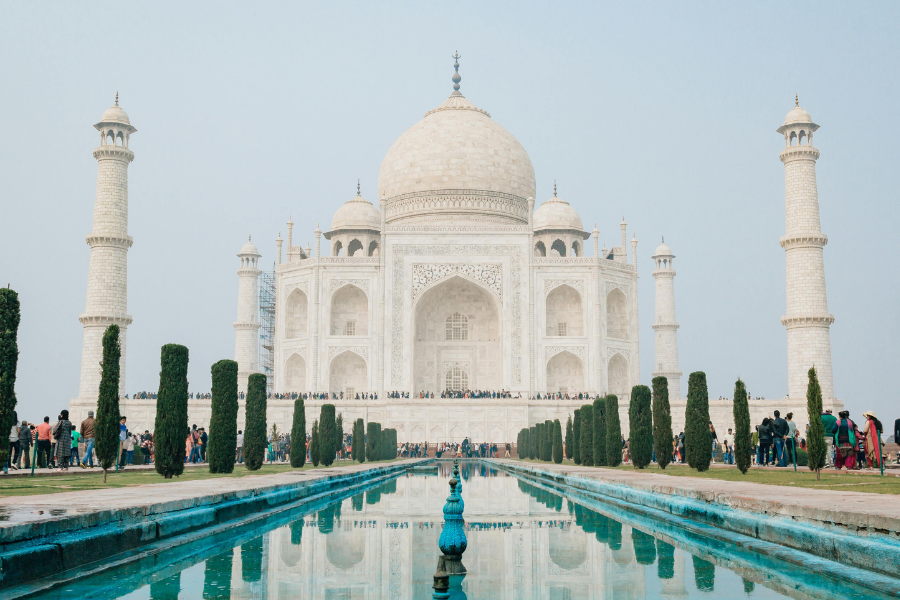
One of the most famous structures in the world and a masterpiece of Mughal architecture is the Taj Mahal. Millions of people visit the monument, which is situated next to the Yamuna River in Agra, Uttar Pradesh, India. It is a unique blend of art, architecture, history, and cultural heritage. The Mughal emperor Shah Jahan constructed the Taj Mahal as a mausoleum for his cherished wife Mumtaz Mahal, and it is frequently referred to as a monument of love. But its tale is far more complex than a straightforward love tale. Thousands of artisans' exceptional skill, the creative traditions of 17th-century India, and the wealth and might of the Mughal Empire are all reflected in its construction.

The Story Behind the Taj Mahal
The history of the Taj Mahal begins with Mumtaz Mahal, whose birth name was Arjumand Banu Begum. She married Prince Khurram, who later became Emperor Shah Jahan, in 1612.
Mumtaz Mahal became Shah Jahan's close buddy and accompanied him on many of his military campaigns and political journeys. The couple had fourteen children.
at 1631, Mumtaz Mahal died at Burhanpur while giving birth to their fourteenth child. Her death severely impacted Shah Jahan. He planned to erect a magnificent mausoleum where she may be permanently memorialized.
Her remains were subsequently relocated to Agra, where the Taj Mahal complex was created.
Construction of the Taj Mahal
Construction of the Taj Mahal began approximately 1632, during the reign of Shah Jahan. The main mausoleum was completely completed by roughly 1638–39, but construction on the surrounding buildings and decorations continued for several more years.
The project required the work of thousands of craftsmen, stonecutters, calligraphers, architects, engineers, and other specialists.
The monument was constructed mostly from white marble, majority of which came from Makrana in Rajasthan. Precious and semiprecious stones were gathered from diverse places and employed for beautiful inlay.
The Taj Mahal was not just created as an isolated tomb. Shah Jahan commissioned a large architectural complex consisting of:
The main white-marble mausoleum
Four minarets
A mosque
A matching guest house
A monumental entrance gate
Formal gardens
Water canals and reflecting pools
Additional structures encircling the complex
The exquisite symmetry of these features is one of the defining aspects of the Taj Mahal.
The Architecture of the Taj Mahal
The Taj Mahal is a masterwork of Mughal architecture, integrating influences from Persian, Central Asian, and Indian architectural traditions.
The central tomb stands on a wide square platform. At its heart is a huge central dome encircled by four smaller domed structures.
Four tall minarets rise at the corners of the platform. Their positioning provides the monument a balanced and symmetrical appearance.
The massive central dome is undoubtedly the most distinctive aspect of the Taj Mahal. Its exquisite design is complimented by decorative finials and smaller domes around it.
White Marble and Stone Inlay
One of the most noteworthy elements of the monument is its intricate ornamentation.
Craftsmen used a method known as pietra dura, in which finely cut fragments of colorful stone are implanted into marble to create flowers, leaves, vines, and geometric designs.
The ornaments include stones such as:
Carnelian
Jade Jasper Lapis lazuli Crystal Agate
These materials generated elaborate patterns that remain evident on the monument today.
Calligraphy
Large panels of Islamic calligraphy decorate the entryway and various elements of the mausoleum. Much of the calligraphy consists of Quranic texts.
The calligraphy was created to appear proportionate when viewed from the ground. This reveals the advanced understanding of visual design used by the monument's craftspeople.
The Taj Mahal Gardens
The Taj Mahal complex has a formal charbagh, or four-part garden, a style influenced by Persian garden traditions.
The garden is separated into sections by water canals and pathways. Reflecting pools create spectacular vistas of the monument, notably along the central axis.
Water has a vital symbolic function in Islamic garden traditions, as the garden might represent an earthly representation of paradise.
The interplay between the garden, river, sky, and marble edifice contributes substantially to the Taj Mahal's visual appeal.
Who Designed the Taj Mahal?
The Taj Mahal was the product of a big team rather than the work of a single man.
Historical documents and traditions identify the project with numerous architects, designers, craftspeople, and calligraphers. Ustad Ahmad Lahori is commonly regarded in historical traditions as the principal architect.
However, historians often emphasize that the monument was a joint achievement involving specialists from several sections of the Mughal Empire and beyond.
This multinational character is reflected in the diversity of architectural and artistic traditions present throughout the complex.
Shah Jahan and the Taj Mahal
Shah Jahan was one of the most significant Mughal rulers and governed from 1628 until 1658.
His rule is often associated with major architectural initiatives. In addition to the Taj Mahal, buildings commissioned during his reign include notable structures in Delhi and Agra.
The Taj Mahal therefore embodies not just Shah Jahan's personal anguish over Mumtaz Mahal but also the tremendous wealth and artistic capabilities of the Mughal Empire at the height of its strength.
What Happened to Shah Jahan?
Shah Jahan's reign ended when his son Aurangzeb assumed control in 1658.
Shah Jahan was incarcerated in Agra Fort, where history maintains that he could see the Taj Mahal from his place of captivity.
He died in 1666.
After his death, Shah Jahan was interred within the Taj Mahal beside Mumtaz Mahal. Their cenotaphs are located in the middle chamber, but their real graves are in the crypt below.
Interestingly, the location of Shah Jahan's cenotaph violates the otherwise tight symmetry of the central interior because Mumtaz Mahal's cenotaph occupies the central position.
The Taj Mahal After the Mughal Empire
After the decline of Mughal rule, the Taj Mahal endured periods of disrepair.
During the 18th century, elements of the monument and its surrounds were not maintained as meticulously as they had been during the Mughal period.
The monument later came under British ownership.
By the late 19th and early 20th centuries, concerns about the deterioration of the Taj Mahal led to conservation and restoration attempts.
One of the main persons engaged with its restoration was Lord Curzon, the British Viceroy of India. Restoration work was carried out to conserve the monument and improve its surrounds.
The gardens were also changed during this period, contributing to features of the appearance tourists see today.
The Taj Mahal After Indian Independence
After India attained independence in 1947, the Taj Mahal became one of the country's most important cultural and tourist monuments.
The Indian government and conservation authorities have continued attempts to conserve the monument from pollution, environmental damage, excessive tourism, and the impacts of time.
The Taj Mahal is currently classified as an important national cultural site.
UNESCO World Heritage Site
In 1983, the Taj Mahal was included on the UNESCO World Heritage List.
UNESCO regards it as an outstanding example of Mughal architecture and defines it as a monument of extraordinary artistic and architectural significance.
Its international prominence has made preservation a primary concern.
The Taj Mahal and Tourism
Today, the Taj Mahal is one of India's most visited attractions.
Visitors travel from around the world to witness its white-marble building, gardens, ornamental elements, and vistas of the Yamuna River.
The monument is particularly famous during sunrise and sunset, when changing light can give the marble varied tints.
The Taj Mahal has also become a prominent icon of India and frequently appears in photography, films, books, paintings, and travel literature.
Myths and Facts About the Taj Mahal
The Taj Mahal has inspired countless stories over the centuries. Some are based on actual traditions, while others are myths.
Myth: The Taj Mahal was created entirely by one architect
Fact: The monument was a vast joint endeavor including architects, craftspeople, engineers, calligraphers, stoneworkers, and other specialists.
Myth: Shah Jahan built a second black Taj Mahal
A common mythology suggests that Shah Jahan designed a black-marble mausoleum for himself over the Yamuna River.
Fact: Archaeological evidence does not demonstrate that a finished or planned black Taj Mahal existed in the way the mythology recounts. The remains across the river are related with the Mehtab Bagh garden.
Myth: The Taj Mahal changes color
Visitors often say the Taj Mahal changes color during the day.
Fact: The marble reflects diverse qualities of natural light, weather, and surrounding hues. This might make the building appear white, cream, pinkish, or gray at different times.
Why Is the Taj Mahal Important?
The importance of the Taj Mahal goes well beyond its beauty.
It represents:
Love: It was erected as a tribute to Mumtaz Mahal.
Architecture: It exhibits the outstanding ability of Mughal architects and craftspeople.
History: It provides insight into the culture, politics, wealth, and artistic traditions of the Mughal Empire.
Art: Its marble carving, stone inlay, calligraphy, and geometric design are excellent examples of craftsmanship.
Heritage: It is one of India's most important cultural landmarks and a UNESCO World Heritage Site.
Interesting Facts About the Taj Mahal
The Taj Mahal is located in Agra, Uttar Pradesh.
Construction began around 1632.
The main construction was mainly built around 1638–39.
The wider complex needed several extra years to finish.
It was commissioned by Shah Jahan.
It was built as a mausoleum for Mumtaz Mahal.
Shah Jahan was later interred beside Mumtaz Mahal.
The monument is mostly built of white marble.
Marble was brought from Makrana, Rajasthan, among other materials acquired from diverse places.
The complex features a mosque and a corresponding guest home.
Four minarets flank the main tomb.
The monument designated a UNESCO World Heritage Site in 1983.
Conclusion
The Taj Mahal is much more than a gorgeous white-marble edifice. It is the outcome of an exceptional period in Mughal history, when architecture, engineering, painting, calligraphy, gardening, and stone craftsmanship came together on an immense scale.
Built by Shah Jahan in commemoration of Mumtaz Mahal, the monument has endured political turmoil, imperial decline, environmental obstacles, and centuries of history. Today, it remains a powerful symbol of love, creative excellence, and India's rich cultural legacy.
Its graceful dome, symmetrical gardens, elaborate marble inlay, fine calligraphy, and connection to the story of Shah Jahan and Mumtaz Mahal have made the Taj Mahal one of the most enduring structures in human history.