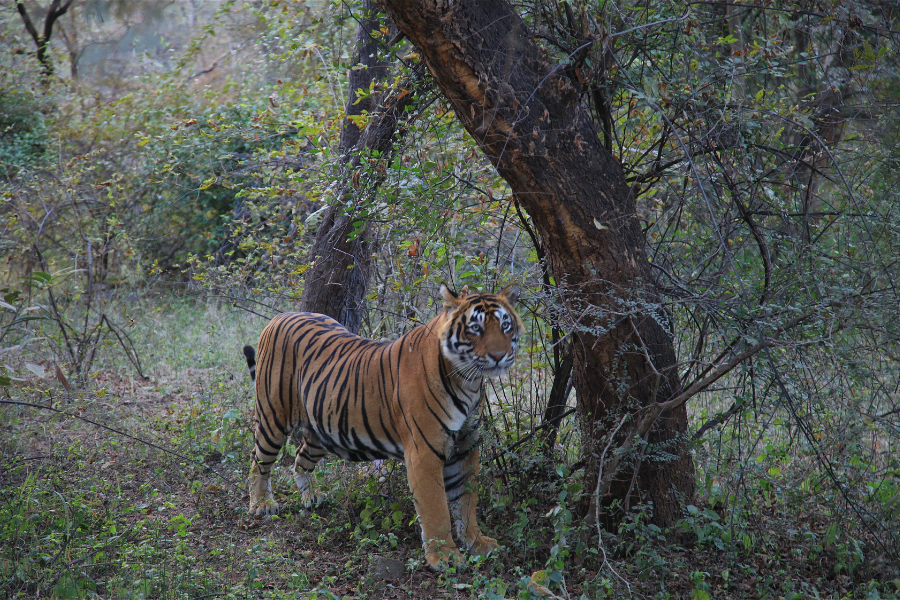
There are few animals on Earth that elicit as much intrigue, respect, and amazement as the tiger. With its strong presence, striking stripes, stealthy movements, and piercing gaze, the tiger has acquired a reputation as one of nature's most stunning predators. But a tiger is much more than a gorgeous animal to capture on safari. It is an essential part of the ecosystem, a symbol of wilderness, and an indicator of the health of the forest it inhabits. From the first tracks discovered on a forest route to the thrilling moment when a tiger emerges from the trees, discovering the world of this majestic animal is an experience that connects us with nature in a meaningful way. Welcome to the world of jungle royalty.

The Tiger: A Symbol of the Wild
The tiger (Panthera tigris) is the largest of the world's big cats and one of the most recognizable predators on the planet.
Its orange coat, marked with black stripes and contrasted by white patches around the face and bottom, gives it a striking appearance. But their famed stripes are more than ornamentation.
They help break up the tiger's outline in forests, meadows, and tall vegetation, making it simpler for the predator to remain camouflaged while approaching prey.
Every tiger's stripe pattern is unique, much like a fingerprint.
This distinctiveness makes each tiger recognizable to expert wildlife researchers and guides.
Where Tigers Live
Tigers have historically colonized a huge territory across Asia. Today, their distribution is much more restricted, and wild populations are concentrated in many nations across Asia.
India is highly essential for tiger conservation and is home to a major amount of the world's wild tiger population.
Indian tiger habitats differ greatly.
A tiger may go through:
Dry deciduous forests
Grasslands
Bamboo forests Wetlands
Riverine forests
Tropical forests
Mangrove landscapes
This versatility is one of the reasons tigers can thrive in such various settings.
The habitat may alter from one reserve to another, but the tiger's function as a top predator remains fairly steady.
The Secret Life of a Tiger
One of the most amazing things about tigers is how much of their lives stay concealed from human eyes.
Tigers are often solitary animals. Unlike lions, which commonly live in social groupings, adult tigers usually prefer to live and hunt alone.
They form and defend territories that can vary substantially in size depending on the availability of prey, habitat, and other environmental factors.
A tiger may spend its day resting beneath plants, traveling through its area, drinking from a water source, scent-marking its surroundings, or seeking for prey.
Much of this happens without humans ever seeing it.
That's why a tiger safari may be so unpredictable.
You may wander for hours through seemingly empty forest and never notice the animal that is silently watching from somewhere close.
The Art of Staying Hidden
Tigers are incredibly proficient at disguise.
Despite their brilliant orange appearance, their stripes can merge remarkably nicely with woodland foliage.
When a tiger glides through tall grass or dappled sunlight, its body can practically disappear into the background.
This camouflage is vital for hunting.
Rather than depending on long-distance pursuit, tigers often adopt stealth. They approach their target stealthily and strive to get as near as possible before delivering a devastating attack.
Their muscular physique, robust forelimbs, keen claws, and powerful jaws make them exceptionally effective predators.
But hunting is never certain.
A tiger might expend tremendous energy chasing prey and still fail to accomplish a successful kill.
That is one reason ensuring robust prey populations is so vital for tiger conservation.
What Does a Tiger Eat?
Tigers are carnivores and depend mostly on other animals for food.
Depending on the locale and available prey, their diet can include animals such as:
Spotted deer
Sambar deer
Wild boar Gaur
Various smaller mammals
Other suitable prey species
The specific diet varies according to habitat.
A healthy forest with abundant prey provides tigers a better chance of survival and reproduction.
This presents an essential conservation lesson:
conserving tigers also involves conserving the entire environment that supports them.
Saving a tiger cannot be divorced from preserving its prey, water supply, forest corridors, and habitat.
The Tiger's Stripes: Nature's Perfect Design
One of the most distinctive traits of the tiger is its striped coat.
No two tigers have exactly the same stripe pattern.
The stripes assist the animal blend into its surroundings and can make its form difficult to detect among grass, branches, shadows, and foliage.
The tiger's physical design is superbly suited to its surroundings.
Its muscular legs allow it to move fast when necessary. Its big paws let it navigate across diverse terrain. Its retractable claws assist with gripping prey and climbing when needed.
Its eyesight and hearing are also key tools for spotting movement in the forest.
Every element of the tiger appears built for survival.
A Tiger Safari: Meeting the King of the Jungle
For many wildlife enthusiasts, the goal of witnessing a tiger in the wild begins with a safari.
Unlike visiting a zoo, a safari gives no certainty.
There are no cages, scheduled appearances, or predetermined itineraries.
You enter the tiger's world on its terms.
A typical safari may begin early in the morning, when the forest is cool and peaceful.
As the car continues down the route, your guide may point out new animal footprints.
Then comes an alert call.
A deer suddenly looks toward the trees.
The jungle becomes unusually calm.
Everyone in the truck gets attentive.
Your guide slows down.
You wait.
And then, perhaps, the forest exposes its secret.
A tiger steps onto the trail.
The Unforgettable Tiger Sighting
Seeing a tiger in the wild is impossible to describe.
At first, you may detect merely movement.
Then the distinctive orange coat appears between the trees.
Suddenly, the animal seems gigantic.
It goes slowly, confidently, and without any care for the people observing from a distance.
The truck becomes silent.
Cameras rise.
But for a few seconds, you may forget about photography altogether.
You simply watch.
The tiger may stop near a tree, look toward the vehicle, and continue walking.
Or it may disappear into the forest almost as swiftly as it appeared.
That brief contact can become one of the most memorable moments of a lifetime.
Beyond the Tiger: The Ecosystem It Protects
A tiger reserve isn't solely about tigers.
It is an entire living network.
Deer feed on greenery.
Herbivores help shape the forest.
Birds disperse seeds and reduce bug populations.
Predators regulate prey quantities.
Trees give food and shelter.
Rivers and waterholes support countless species.
The tiger lies toward the top of this ecological system.
As an apex predator, it helps preserve balance within the ecosystem by affecting populations of prey animals.
This is why tiger conservation has benefits far beyond the tiger itself.
When a tiger habitat is protected, countless other species benefit too.
The Importance of Tiger Conservation
Wild tigers have faced major dangers throughout the past century.
Historically, habitat degradation, hunting, poaching, and dwindling prey populations caused tiger numbers to plummet substantially.
Although conservation projects have achieved substantial results in numerous regions, wild tigers still confront significant problems.
Some of the significant threats include:
Habitat Loss
Forests are under threat from agriculture, infrastructure, urbanization, and other forms of development.
Habitat Fragmentation
Even when forest persists, roads, railways, farms, and settlements can divide habitats into smaller pieces.
This can make it difficult for tigers and other species to move between groups.
Poaching
Illegal hunting is a severe threat to tigers and their prey.
Human-Wildlife Conflict
As human settlements expand near wildlife habitats, confrontations between people and wild animals can rise.
Declining Prey
A forest cannot support numerous tigers if there isn't enough prey.
Conservation therefore entails maintaining the overall ecosystem rather than focusing on one species alone.
Tiger Reserves: Protecting the Wild
Tiger reserves and protected areas provide crucial secure habitats for these magnificent cats.
Across India, various protected landscapes have become key sites for tiger conservation and wildlife tourism.
Some well-known destinations include:
Ranthambore Jim Corbett Kanha Bandhavgarh Pench Tadoba-Andhari Nagarhole Bandipur Satpura Sundarbans
Each reserve offers a diverse landscape and wildlife experience.
Some are recognized for open grasslands, others for lush woods, rivers, marshes, or unusual scenery.
The potential of witnessing a tiger is exhilarating, but each reserve offers something more valuable: an opportunity to observe a functioning natural environment.
The Unique World of the Royal Bengal Tiger
Among India's tiger populations, the Royal Bengal Tiger retains a particularly iconic place.
It is strongly related with the forests and wetlands of the Indian subcontinent, notably the unique mangrove environment of the Sundarbans.
The Sundarbans exhibit a totally different environment from the arid forests of central India.
Here, canals, mudflats, mangroves, and tidal landscapes shape the lives of species.
The tiger's ability to survive in such tough terrain illustrates its extraordinary flexibility.
The Best Time for a Tiger Safari
The optimal time for a safari depends on the specific reserve and what you want from the trip.
The cooler months can be comfortable for visitors and offer pleasant safari conditions.
During warmer periods, vegetation may become less dense and wildlife may spend more time around water sources, thus making creatures easier to spot.
However, weather conditions, park regulations, and seasonal closures vary.
Before reserving, guests should verify the latest information about their chosen reserve, including:
Park opening dates
Safari times
Permit availability
Weather conditions
Seasonal restrictions
Accommodation options
Local wildlife guidelines
Planning ahead can make the experience much smoother.
How to Make the Most of a Tiger Safari
Seeing a tiger is never totally within your control.
But you may improve your overall experience by approaching the safari with patience and modest expectations.
1. Listen to Your Naturalist
Experienced guides understand animal behavior and know how to interpret alarm cries and tracks.
2. Carry Binoculars
You may spot birds, deer, monkeys, and distant wildlife that you might otherwise miss.
3. Be Patient
Wildlife sightings aren't guaranteed. Enjoy the forest even when the tiger remains hidden.
4. Keep Quiet
Excessive noise might upset wildlife and diminish your chances of viewing natural behavior.
5. Respect the Rules
Park restrictions exist to safeguard both tourists and animals.
6. Don't Chase Wildlife
A prudent safari never emphasizes a snapshot over an animal's well-being.
The Photography Challenge
Photographing a tiger in the wild involves patience, time, and a little luck.
You may meet challenging lighting, dense undergrowth, or a tiger that emerges for only a few seconds.
A telephoto lens can be advantageous, especially because maintaining a safe distance is crucial.
Try to catch more than just the tiger's face.
A photograph displaying the tiger inside its habitat might convey a far deeper tale.
And remember:
The best safari shot isn't usually the sharpest one. Sometimes it's the image that brings back the feeling of the moment.
Responsible Tiger Tourism
Wildlife tourism can play a significant part in conservation when performed ethically.
Visitors contribute to local economies through park fees, housing, guides, transportation, and other tourism services.
But tourism must be managed wisely.
Responsible visitors should:
Maintain a safe distance from animals.
Never feed wildlife.
Never litter.
Follow designated routes.
Avoid loud noises.
Respect park staff and local communities.
Never encourage drivers to chase animals.
Avoid disturbing animals for pictures.
The goal is simple:
Observe wildlife without affecting its behavior.
The Jungle Is the Real Destination
Perhaps the most significant lesson of a tiger safari is that the tiger is only one element of the experience.
The true destination is the jungle.
It is the sound of birds at sunrise.
The tracks in the mud.
The movement of deer through tall grass.
The rustling leaves.
The fragrance of damp ground after rain.
The golden light between trees.
The abrupt hush before an animal arrives.
And, occasionally, the distinct sight of a tiger roaming across it all.
That is what makes the experience so compelling.
Why Tigers Matter
Tigers represent something broader than themselves.
They signify wilderness.
They indicate healthy woodlands.
They reflect the prospect that humans and wildlife can share a world without one fully displacing the other.
When we safeguard tiger habitat, we protect water sources, forests, prey species, birds, insects, plants, and countless other forms of life.
A tiger reserve is therefore not merely a place where tigers live.
It is a living conservation narrative.
A Journey You Will Never Forget
As the safari comes to a conclusion, the jungle begins to vanish behind you.
Perhaps you saw a tiger.
Perhaps you didn't.
But either way, you leave with something.
You have learned to look at the landscape differently.
You have found that a footprint can tell a narrative.
You have heard the alarm call of a deer.
You have observed birds move across the canopy.
You have experienced the weird excitement of waiting for something you cannot control.
And if you were lucky enough to witness a tiger, you now understand why people travel thousands of kilometers for that single instant.
The tiger doesn't need to roar to command attention.
Its presence is enough.
Final Thoughts: Respect the Royalty of the Wild
The tiger is sometimes considered the king of the jungle, but perhaps a truer description is the monarchy of the wild.
It doesn't reign by dominance alone. Its survival depends on the health of the entire ecosystem around it.
safeguard the forest, and you safeguard the tiger.
Protect the tiger, and you help protect the jungle.
That is the fundamental significance behind every safari.
So, the next time you walk a forest trail and find fresh tracks in the mud, stop for a while.
Look around.
Listen carefully.
Somewhere beyond the woods, hiding amid the shadows, jungle royalty may be strolling stealthily across its ancient domain.
And that is where the real adventure begins. 🐅🌿